Meta Andromeda Update Explained (2026) - Changes In Strategy

Between late 2024 and 2026, Meta rebuilt the core intelligence layer that decides how ads are selected, evaluated, and delivered. That meta ad update is known internally as Andromeda. Most advertisers never saw it roll out. They only felt the symptoms: unstable performance, weaker targeting levers, and creative volatility that seemed to defy past best practices.
Andromeda represents a philosophical shift in Meta ads updates. Meta is no longer optimizing ads primarily around who advertisers think their audience is.
It is optimizing around what the system can predict people will do.
The Meta Andromeda update is a foundational change. The AI overhaul powers ad retrieval, ranking, and personalization using predictive modeling and creative performance signals. It reduces reliance on manual targeting and elevates creative diversity, behavioral data, and automation as the primary drivers of performance in 2026.
For better results in ads, you can consider buying verified Facebook Accounts.
Meta Andromeda Update: At A Glance

Among the meta ads updates, Andromeda is Meta’s new retrieval engine. It’s the layer of the ad system responsible for scanning an almost unimaginable volume of ads. It also identifies which ones are even eligible to be shown to a specific user at a particular moment. This happens before bidding, before optimization, and even before most advertisers realize a decision has been made.
In earlier generations of Meta Ads, this retrieval process leaned heavily on advertiser-defined inputs. Interests, demographics, lookalikes, and exclusions acted as hard gates that determined which ads entered the auction. Andromeda fundamentally softens those gates.
Instead of treating audience definitions as the primary signal, Andromeda prioritizes creative performance data and real behavioral patterns. It evaluates how people have historically interacted with similar messages, formats, and narratives, and uses those signals to infer relevance dynamically.
The net effect is a philosophical shift. Meta is no longer trying to show ads to people because of who advertisers think they are.
It is increasingly showing ads to people because:
- How they behave
- What they engage with
- What the system predicts they will respond to next.|
Andromeda is not a dashboard feature, a campaign setting, or a toggle you can turn on or off. It is a behind-the-scenes AI and machine learning synapse that sits deep within this Facebook ads update, quietly coordinating how creative signals, engagement patterns, and predictive models work together.
In Meta’s own architecture, Andromeda operates at the retrieval stage of ad delivery. Its job is to narrow down tens of millions of potential ads into a much smaller pool of viable contenders before the ranking and auction stages even begin.
This stage is critical because it determines which ads get a chance to compete at all. If an ad is never retrieved, bid size and optimization settings become irrelevant.
Meta has framed this shift as unavoidable. With Advantage+ campaigns, automated placements, and generative creative tools dramatically increasing the number of ad variations in circulation, the legacy retrieval layer could no longer keep up.
Andromeda meta addresses that bottleneck by:
- Processing massive datasets faster, recognizing deeper behavioral patterns
- Making probabilistic relevance decisions at scale, something older rule-based systems simply could not do.
When Did Meta Roll Out the Andromeda Update?
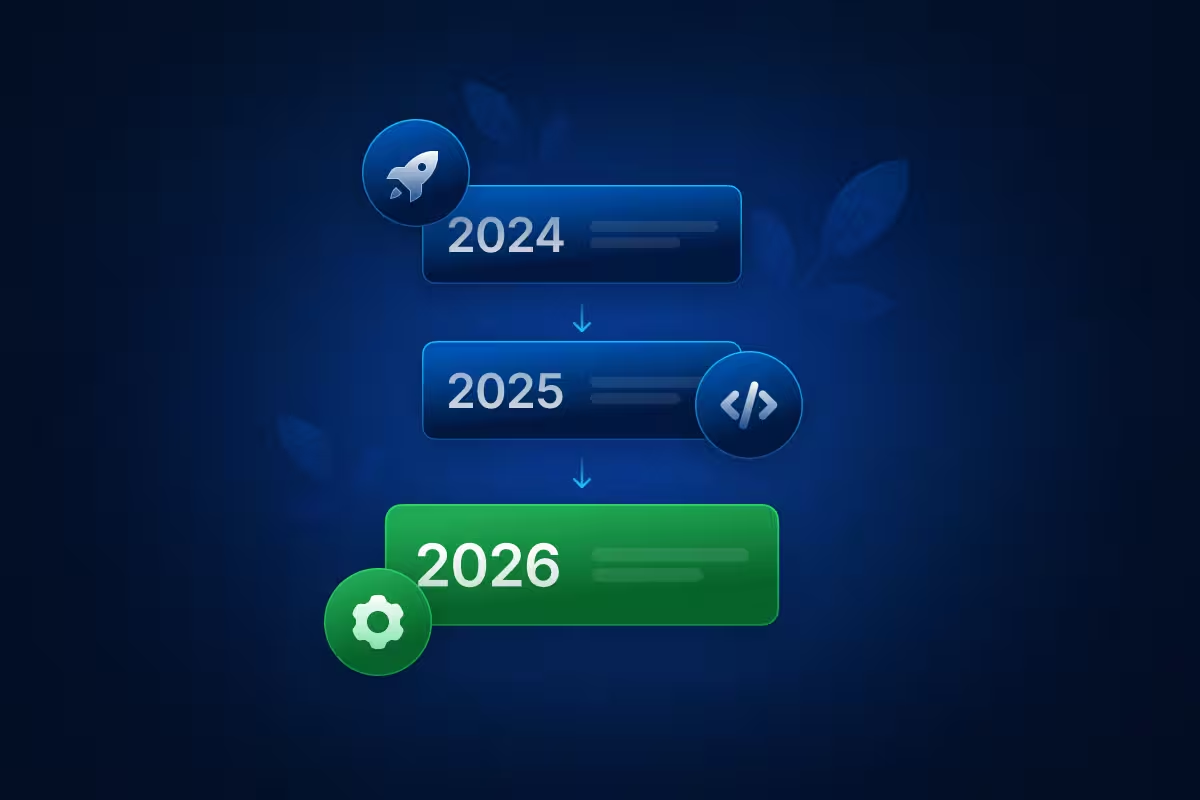
Andromeda did not arrive with a press release or a visible UI change. There was no single launch date. However, the global completion was around October 2025. Instead, Meta introduced it gradually, layering its influence into the ad system over multiple years to avoid destabilizing performance at scale.
The rollout followed a phased trajectory:
Andromeda became the primary engine shaping ad eligibility and delivery across most objectives and placements
Because of this deliberate, incremental integration, advertisers often experienced Andromeda’s effects in uneven waves rather than a single, obvious shift. Performance changes felt episodic, with periods of instability followed by normalization. This is precisely because Meta was tuning and expanding Andromeda in the background rather than flipping a switch all at once.
Also, check out your Facebook Feedback Score here.
Why Did Meta Introduce the Andromeda Update?
Meta’s goal isn’t novelty, but scale and relevance. The newest Andromeda Update covers two big drivers in Meta’s checklist:
- Massive creative inflation: With tools like Advantage+ Creative and AI ad generation, the volume and diversity of ad assets exploded. Legacy retrieval choked on this scale.
- Targeting limitations post-privacy era: Interest and demographic signals became weaker. Andromeda moves Meta away from stale audience constructs toward behavioral signals and engagement outcomes as the true driver of personalization.
What the Meta Andromeda Update Actually Changes
Now, let's take a look at what actually changes thanks to the Andromeda update.
From Targeting Signals to Creative Signals
Under Andromeda, creative relevance effectively becomes the audience. Meta has been increasingly explicit that the system is moving away from narrow, interest-based targeting and toward creative diversification as the most reliable lever for performance at scale.
In earlier iterations of Meta Ads, targeting decisions happened largely before creative ever mattered.
Advertisers defined the audience first, and creatives competed only within those boundaries. Andromeda reverses that sequence.
In practical terms, for this Facebook ads update:
- Interests still inform learning, but they no longer act as rigid gates that control delivery. They provide context, not command.
- The algorithm now leans heavily on how people interact with ads, including subtle engagement behaviors, rather than on how users are labeled or categorized in the system.
This represents a seismic reframe.
Instead of advertisers choosing audiences and hoping the creative resonates, Andromeda allows creatives to find their audience through interaction patterns.
The message, the hook, and the ad's framing implicitly define who it reaches. In effect, every creative becomes a self-selecting filter.
How AI Ranking Works Under Andromeda
Andromeda is built for predictive matching, not static delivery. It does not simply distribute ads evenly or reactively. It anticipates outcomes.
Rather than asking, “Who fits this audience definition?” the system asks, “Who is most likely to respond positively to this specific creative right now?”
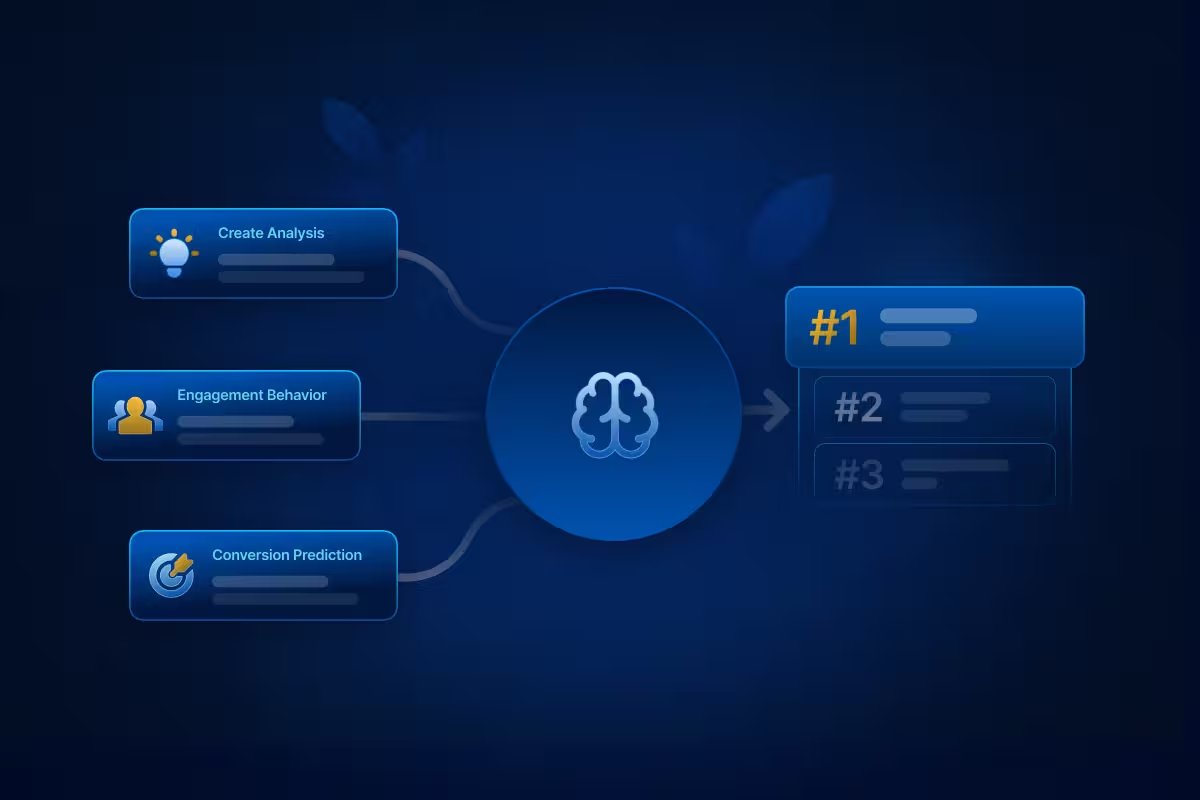
Andromeda continuously evaluates multiple layers of data:
- Analyzing creative elements such as hooks, themes, formats, pacing, visual structure, and narrative style to understand what kind of attention an ad is designed to attract.
- Observing engagement patterns, including watch time, scroll behavior, skips, clicks, and how early interactions correlate with downstream actions over time.
- Modeling conversion likelihood, not just estimating who might convert, but predicting who is statistically most likely to complete a desired action based on similar past behaviors.
This modeling happens in near real time and is constantly updated as new data flows in. The result is a delivery system that adapts dynamically, redistributing impressions toward users who resemble prior converters in behavior, not demographics.
Why Advertisers Are Seeing Mixed Performance
The performance volatility many advertisers experience under Andromeda is a natural consequence of this transition. As this is another biggest Meta Ads Manager updates, there are several forces.
Several forces are at play:
- Traditional targeting signals are weaker, and legacy segmentation tactics don’t have the same efficiency. They do not provide strong predictive value in isolation.
- Creative variety now matters significantly more. Accounts with narrow or repetitive creative libraries often experience instability. The system lacks enough signal diversity to learn effectively.
- Andromeda’s learning curves can feel slower at first, as the AI explores broader possibilities. However, once sufficient creative and behavioral data accumulates, optimization tends to widen rather than narrow, producing more resilient performance over time.
Creative Volume Is the New Targeting
Meta itself states that creative diversification and not narrow audiences is the most potent lever advertisers have today. Creative volume supplies the raw material Andromeda needs to do its job.
Each additional, meaningfully different ad gives the system another lens through which to interpret intent, preference, and readiness to act.
Minimum Creative Volume Requirements
To compete effectively under Andromeda, advertisers must rethink what “enough creatives” actually means.
In practice, that requires:
- Providing enough distinct ads in an ad set, typically more than six, so the system has real options rather than forced repetition.
- Including widely differentiated hooks and formats, not just cosmetic changes like color swaps or headline tweaks. However, they have fundamentally different entry points into the same offer.
- Avoiding near-duplicates that recycle the same message structure, pacing, or emotional appeal.
Creative Diversity Explained
Creative diversity is not about randomness. It is about intentional contrast.
The goal is to give the algorithm multiple, clearly differentiated interpretations of the same value proposition. It can test, compare, and match them to different psychological profiles.
Different Hooks & Angles
Some users respond to problem agitation. Others respond to aspiration, identity alignment, or social proof. A single hook cannot activate all of these motivations.
- Problem-focused creatives resonate with users experiencing friction.
- Desire-focused creatives attract those imagining a better outcome.
- Identity-focused creatives appeal to how people see themselves, or want to be seen.
Awareness Levels (Cold → Hot)
Users exist at different stages of awareness, and Andromeda is sensitive to that progression.
- Cold audiences require framing, education, or curiosity to earn attention.
- Warm audiences look for validation, credibility, and relevance.
- Hot audiences want reassurance, urgency, or friction removal.
Avatars & Buyer Personas
Effective creative does not speak to a single, generalized customer. It speaks to a range of motivations, objections, and contexts.
Different personas interpret the same offer through different lenses, like budget sensitivity, status, convenience, risk tolerance, or long-term value.
Andromeda performs best when creatives address a constellation of user needs, letting behavior, not assumptions, determine who sees what.
How Meta Andromeda Affects Different Ad Objectives & Industries
Andromeda is technically an engine, not a magic wand. Its effects vary by objective. This is also one of the biggest meta ads manager updates as well.
- E-commerce: benefits from clear conversion data and rapid creative exploration
- Lead Gen: faces noise if form completion signals are thin
- Niche B2B or local services: may see slower learning without solid creative signal inputs
Why “One Winning Ad” No Longer Scales
Old playbooks leaned on a single champion ad. Andromeda exposes the limits of that thinking.
Because the AI matches creatives to different micro-preferences, a “one size fits all” winner yields narrow performance and quick fatigue.
Now, creative ecology, a rich library of relevant messages, drives lasting performance.
How Meta Andromeda Impacts Campaign Structure
Now, let's take a look at what you should take care of when running campaigns after the new update:
Simpler Campaign Structures Win
Under Andromeda, over-segmentation fights the algorithm.
A broad structure:
- Let AI identify patterns
- Prevents internal budget cannibalization
- Reduces decision friction
Open Targeting & Broad Campaigns Explained
Where targeting used to choke the signal, open targeting now amplifies it. The AI can explore more widely, then pull back based on performance.
Exclusions still matter, especially for bad actors, non-buyers, or internal audience noise. But targeting is less prescriptive and more responsive.
Why Testing and Scaling Must Be Separated
Testing thrives on variance. Scaling thrives on consistency.
Blending them in one campaign resets learning as fast as it gains traction.
Instead:
- Separate creative discovery from scaling execution
- Let signal accumulation finish before turning up the spend
Meta Andromeda Strategies by Budget Size
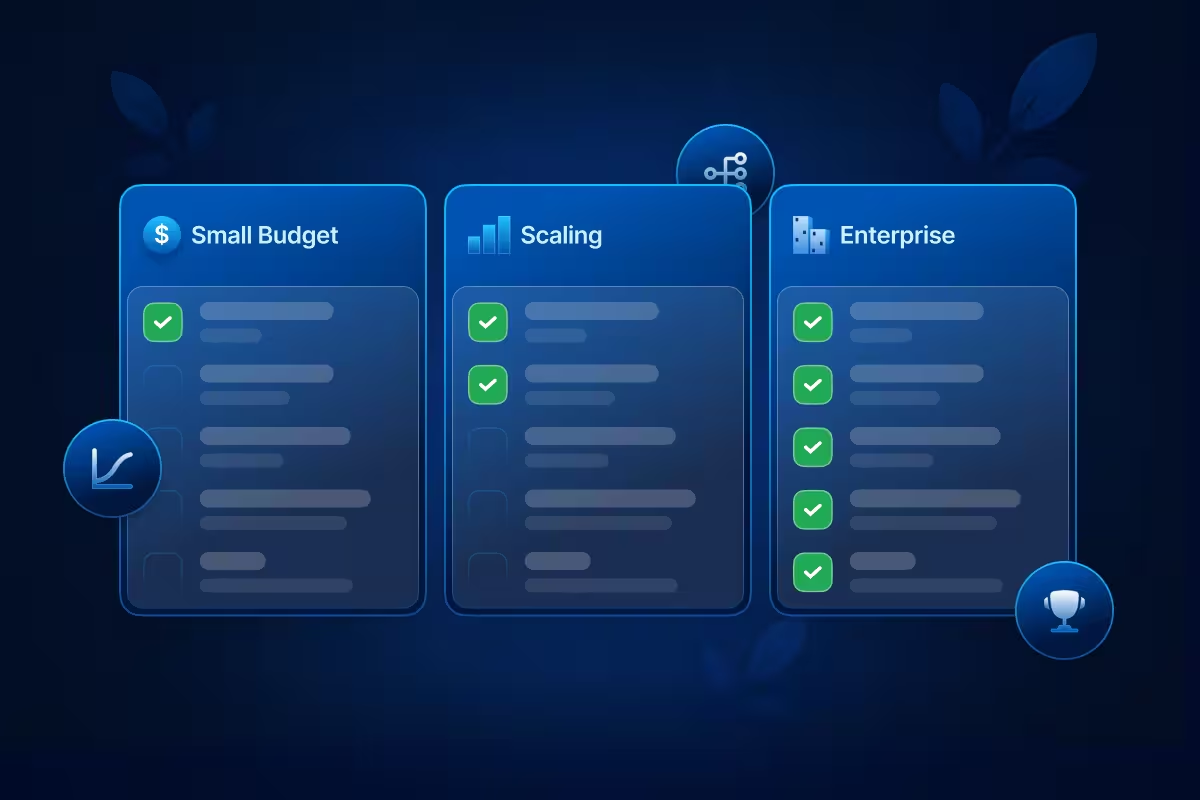
- Small Budget: fewer campaigns + broad high-performing creatives
- Scaling: systematic variation frameworks
- Enterprise: robust creative factories + automation oversight
Meta Automation Tools Under Andromeda
Meta’s automation tools like Advantage+ are deeply aligned with Andromeda’s logic. They extend automated placement, optimization, and budget allocation. However, they only work if the signal quality is rich.
Creative Testing & Refresh Strategy After Andromeda
Rather than chasing short-term wins or rotating ads randomly, successful advertisers adopt structured refresh models that balance exploration with stability.
The 50 / 30 / 20 Creative Refresh Model
This is the refresh strategy you should follow after the update:
50% new concepts
These are fundamentally new ideas. New angles, new narratives, new hooks, and often new formats. Their purpose is not immediate efficiency, but discovery. They expand the system’s understanding of what could work and open new learning pathways.
30% refined variants
These build on existing signals. The core idea remains intact, but elements such as the opening hook, pacing, framing, or CTA are adjusted. This layer improves efficiency and sharpens message-market fit without destabilizing performance.
20% proven performers
These are your known contributors. They provide continuity, anchor learning, and prevent performance from collapsing during experimentation. They also act as benchmarks against which new ideas are evaluated.
How Often Should You Refresh Creatives?
Under Andromeda, refresh cadence should be signal-driven, not schedule-driven.
Forget arbitrary rules like “every two weeks” or “once per month.” Instead, pay attention to the indicators the system surfaces naturally:
- Rising costs, especially CPA drifting upward without corresponding scale gains
- Falling CTRs or engagement metrics, which suggest audience fatigue or declining relevance
- Escalating CPMs is often a sign that the system is struggling to find efficient matches for existing creatives
These shifts are early warning signs. They indicate diminishing marginal returns, not necessarily creative failure. When multiple signals align, the machine is effectively telling you it needs new inputs.
Tracking, Data & Signal Quality Under Andromeda
If creativity is the fuel, data is the engine oil. Without clean, consistent conversion signals, even the most advanced AI will learn the wrong lessons.
This meta advertising update depends heavily on outcome data to validate predictions. When signals are distorted, optimization follows false patterns.
Common problems include broken events, duplicate firing, and incomplete attribution paths. Each introduces noise that compounds over time.
To protect signal integrity, ensure:
- Pixel and CAPI are firing consistently, with redundancy rather than reliance on a single method
- One prioritized conversion event is clearly defined and aligned with true business outcomes
- High-quality leads and outcome signals, not vanity conversions that inflate volume without value
3 Biggest Risks Advertisers Face with Meta Andromeda

Several risks become more pronounced under Andromeda’s logic:
- Creative bottlenecks slow signal growth: When creative production cannot keep pace with learning needs, the system exhausts existing signals and performance decays.
- Over-optimization resets learning loops: Excessive edits, constant structure changes, or frequent resets interrupt learning before patterns can stabilize.
- Small budgets dilute the signal with too much variation: While diversity matters, spreading limited spend across too many creatives can prevent any single signal from maturing.
3 Things Advertisers Should Do Now
- Build a high-velocity creative pipeline: Schedule regular creative output rather than ad-hoc production. Consistency matters more than bursts of effort.
- Expand messaging using UGC and native formats: Human, imperfect, platform-native storytelling consistently outperforms polished, brand-heavy ads because it aligns with how people consume content.
- Split budgets between discovery and scaling: Protect learning environments while allowing proven creatives to scale without interference. Exploration and exploitation serve different purposes and should not compete for the same budget.
Taken together, these actions align operations with how Andromeda actually learns, through steady input, clear signals, and room to adapt.
3 Common Myths & Misconceptions About Meta Andromeda
Final Words: Adapting to the New Reality
The Meta Andromeda update marks the permanent shift from precision targeting to predictive relevance. For advertisers, this means letting go of micromanagement and embracing the philosophy that “creative” is the new audience.
Success in the 2026 Meta Ads landscape is defined by the richness of your creative library, the clarity of your conversion data, and your willingness to trust the algorithm with broader delivery mandates.
Try using agency ad accounts from Uproas to make your shift to Andromeda smoother and more effective.
Focus on building a continuous, systematic creative pipeline, maintaining pristine data signals, and structuring campaigns simply to give Andromeda the room it needs to find and convert your best customers at scale. The goal is no longer control, but optimal signal flow.
Frequently Asked Questions
Does Meta Andromeda replace targeting completely?
No. Targeting is still relevant, but the creative signal plays a much larger role.
Can one winning ad still scale?
Momentarily. Long-term performance comes from diversity and signal strength.
How many creatives do I need per campaign?
Enough to reflect real variations, often more than what old rules suggested.
Is Advantage+ mandatory after Andromeda?
Not mandatory, but well-aligned with the underlying AI logic.
Does Andromeda favor big advertisers?
Not size itself, but signal density and creative diversity matter most.
How often should creatives be refreshed in 2026?
When signals flatten or decay, not follow fixed schedules.


Latest blogs
Marketing Mix Modeling: Master Revenue Growth
Stop trusting broken attribution data. Learn how marketing mix modeling bypasses tracking limits to uncover true revenue and optimize ad spend.
Types of Retargeting: The Full Guide for Marketers
Explore major types of retargeting, from pixel-based to dynamic and sequential, and learn how to combine them into a converting campaign.
Targeted Advertising: How It Works and How to Use It Well
Build a bulletproof targeted advertising strategy. Turn raw behavioral data into profitable segments using our step-by-step optimization plan.
Retargeting vs Remarketing: The Difference Every Marketer Needs to Know
Stop treating Retargeting vs Remarketing as identical. Use a precise, high-impact framework to weaponize your data and maximize conversions.

Google Ads Cost: What You'll Really Pay (By Industry, Campaign Type, and Business Size)
Stop wasting budget on vague pricing. See exact 2026 Google ads cost benchmarks by industry, real CPC data, and the formula to reduce your ad spend.

Types of Facebook Ads: A Complete Guide to Every Format in 2026
See all types of Facebook ads, including current specs, placements, and objectives, plus a matching table to pick the right format for your goal.
ABM Stats: 2026 Benchmarks, ROI & Trends
From ROI to pipeline velocity, these 2026 ABM stats show exactly why account-based marketing dominates B2B growth.
.jpg)
The Real Price of Social Media Advertising: A Cost Guide for Advertisers
Find out what social media ads actually cost these days. Get to know about CPC, CPM, CPL, industry verticals, budget ranges, and ROAS across major platforms.
Bing Ads Cost in 2026: Everything You Need to Know
Stop wasting money on ad spend. See the 2026 Bing Ads cost benchmarks, real industry CPAs, and hidden ROI data you need to outperform competitors.