Best Agency Ad Account Providers in 2026 (Trusted, Scalable & Ban-Resistant)

Advertising platforms in 2026 operate under stricter rules, heavier automation, and more aggressive enforcement systems than ever before.
Meta, Google, TikTok, and other major networks rely heavily on AI-driven monitoring to detect policy violations, suspicious behavior, and financial risks. While this protects platforms, it creates serious operational challenges for agencies.
For marketing teams managing multiple clients, high monthly budgets, and competitive niches, account instability is no longer a minor inconvenience. A single suspension can pause dozens of campaigns, disrupt client relationships, and damage revenue.
This is why many agencies now work with professional ad infrastructure providers such as Uproas. These companies offer access to established agency ad accounts designed for scalability, compliance, and long-term performance.
In this guide, we examine the best agency ad account providers in 2026, explain how agency ad accounts work, and outline how to choose the right provider based on your operational needs rather than marketing hype.
Agency Ad Accounts Explained
Agency ad accounts are professionally managed advertising accounts created within large-scale business portfolios. They are usually linked to registered companies, verified documents, stable payment systems, and long-standing advertiser profiles.
These accounts are not shortcuts or gray-market assets. In most cases, they are built through official programs, enterprise partnerships, or long-term platform relationships. Providers maintain dozens or even hundreds of such accounts under unified management.
When an agency uses one of these accounts, it effectively plugs into a larger ecosystem. This ecosystem spreads risk, centralizes compliance, and allows issues to be handled at scale.
The practical result is greater operational resilience. If one account faces review, the provider can often manage the situation without halting the agency’s entire operation.
What Is an Agency Ad Account Provider?
An agency ad account provider is a company that supplies advertising accounts to agencies under its own verified business infrastructure. Instead of operating through personal profiles or newly created business managers, agencies use accounts that belong to the provider’s corporate entity.
These providers invest heavily in building compliant business structures, maintaining platform relationships, and managing financial systems. As a result, the accounts they offer typically have stronger trust signals, longer histories, and higher spending capacity than standard accounts.
The provider remains the legal owner of the account, while the agency receives controlled access for campaign management. This arrangement allows agencies to focus on media buying and optimization without constantly worrying about account survival.
Each provider below serves a different segment of the agency market. Understanding their positioning helps match infrastructure to business strategy.
1. Uproas.io
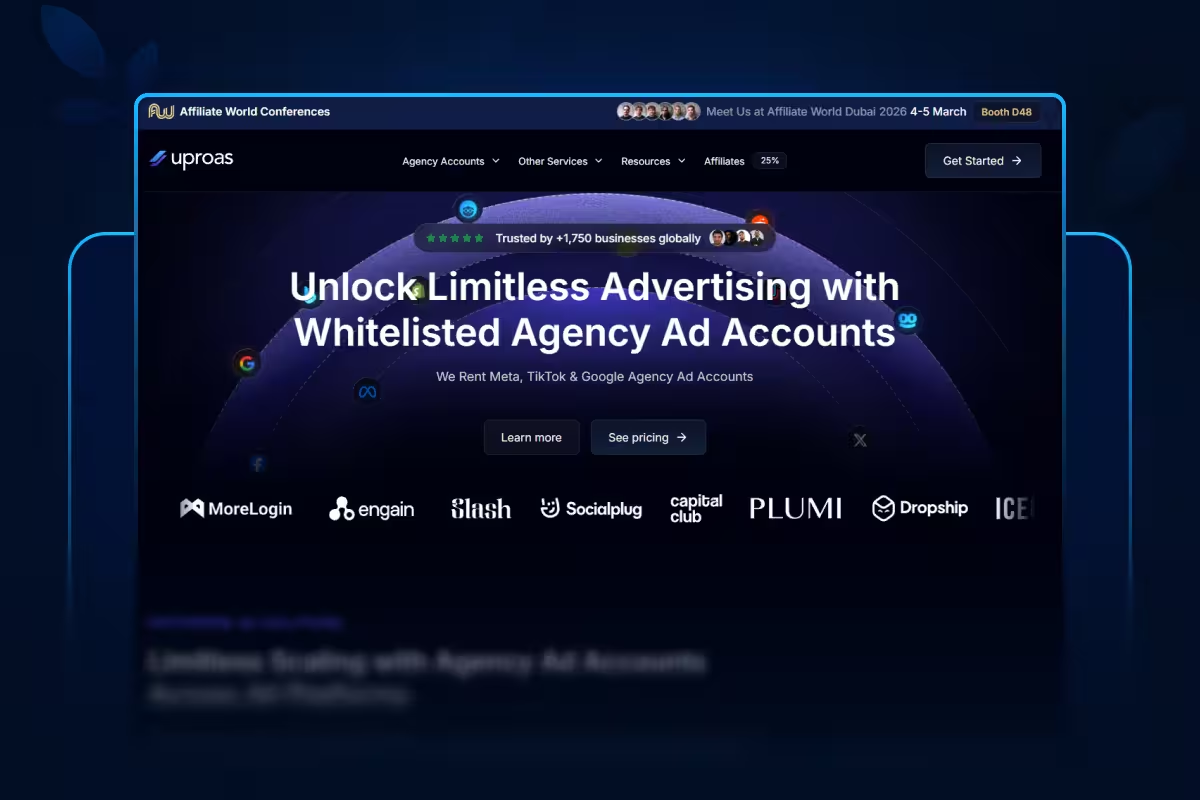
Uproas has positioned itself as a long-term infrastructure partner for agencies that want stability without sacrificing flexibility. Rather than focusing only on quick access or aggressive scaling alone, Uproas emphasizes sustainable growth, compliance alignment, and predictable operations.
Its platform is designed for agencies that manage multiple clients and need consistent performance across campaigns, billing, and account health.
We invest heavily in onboarding processes, account monitoring, and internal compliance systems. This makes Uproas particularly attractive for agencies that want to minimize disruption and avoid frequent account rebuilding. Instead of treating ad accounts as disposable assets, Uproas treats them as long-term business resources.
Uproas also maintains a strong focus on transparency. Agencies typically receive clear guidelines on acceptable practices, platform limitations, and risk management expectations. This helps teams plan campaigns more effectively and reduces uncertainty when scaling.
Overall, Uproas is best viewed as a reputed, reliability-focused provider rather than a high-risk or short-term solution.
Key Features
- Agency Ad Accounts for most platforms, including Facebook, Google, TikTok, Bing, Outbrain, and Taboola.
- Access to established agency ad accounts with verified business infrastructure
- Multi-platform support across major advertising networks
- Centralized compliance monitoring and risk management systems
- Structured onboarding and account setup process
- Dedicated account management and operational support
- Integrated billing and payment routing solutions
- Flexible pricing options
Pros
- 1% cashback on spend
- Ad approval in 5 minutes
- Very high ad approval rate
- Accounts with platinum tier HiVA score
- Supports major advertising platforms including Meta, Google, and TikTok
- Provides dedicated account managers for ongoing support
- Well-documented onboarding and compliance guidelines
- Stable and predictable billing systems
- Strong reputation for account longevity
Cons
- Limited time access for new users
2. AdLaunch

AdLaunch is built primarily for large agencies and enterprise-level advertisers that require highly structured systems, strict compliance controls, and predictable operational performance. Rather than targeting small or mid-sized teams, AdLaunch focuses on organizations managing substantial monthly ad spend across multiple regions and verticals.
The company places strong emphasis on backend reliability, financial transparency, and contractual accountability. Its infrastructure is designed to support complex billing arrangements, multi-department reporting, and long-term client portfolios. As a result, onboarding with AdLaunch tends to be more formal and documentation-heavy than with smaller providers.
AdLaunch also invests heavily in internal compliance teams and platform relationships. This allows it to handle escalations, reviews, and disputes more effectively than many mid-market providers. However, this enterprise focus can make the platform less flexible for fast-moving or experimental agencies.
Overall, AdLaunch is best suited for agencies that prioritize institutional stability, regulatory alignment, and long-term planning over rapid deployment.
Key Features
- Enterprise-grade ad account infrastructure
- Advanced billing, invoicing, and reconciliation systems
- Dedicated compliance and risk management teams
- Service-level agreements and formal support structures
- Suitable for high-risk niches
- Multi-region account deployment capabilities
- Detailed reporting and audit tools
Pros
- High spending capacity and scalability
- Reliable financial and reporting systems
- SLA-backed support
Cons
- High minimum requirements
- Lengthy onboarding process
- Limited flexibility for smaller agencies
- Less suitable for short-term campaigns
3. UVAds

UVAds operates in a more aggressive segment of the market, serving affiliates, arbitrage teams, and high-turnover traffic operations. Its business model is built around speed, flexibility, and rapid account deployment rather than long-term account preservation.
The platform is designed for advertisers who expect frequent reviews, suspensions, and replacements as part of their normal workflow. Instead of trying to eliminate risk entirely, UVAds focuses on managing it through redundancy and rotation systems.
This approach makes UVAds attractive to marketers working in competitive or borderline niches where account lifespan may be unpredictable. The company prioritizes fast access and replacement availability over extensive compliance consulting.
While this model enables rapid scaling, it also means that account stability may be lower than with infrastructure-focused providers. Agencies using UVAds must be comfortable operating in high-risk environments.
Key Features
- Account rotation and replacement systems
- Rapid account provisioning processes
- Support for high-risk and competitive niches
- Flexible access models for affiliates
- High-volume deployment capabilities
- Risk distribution across multiple accounts
Pros
- Fast setup and activation
- Strong support for affiliate traffic models
- Flexible usage structures
Cons
- Lower long-term account stability
- Limited strategic guidance
- Higher operational risk
4. Kayoads.com
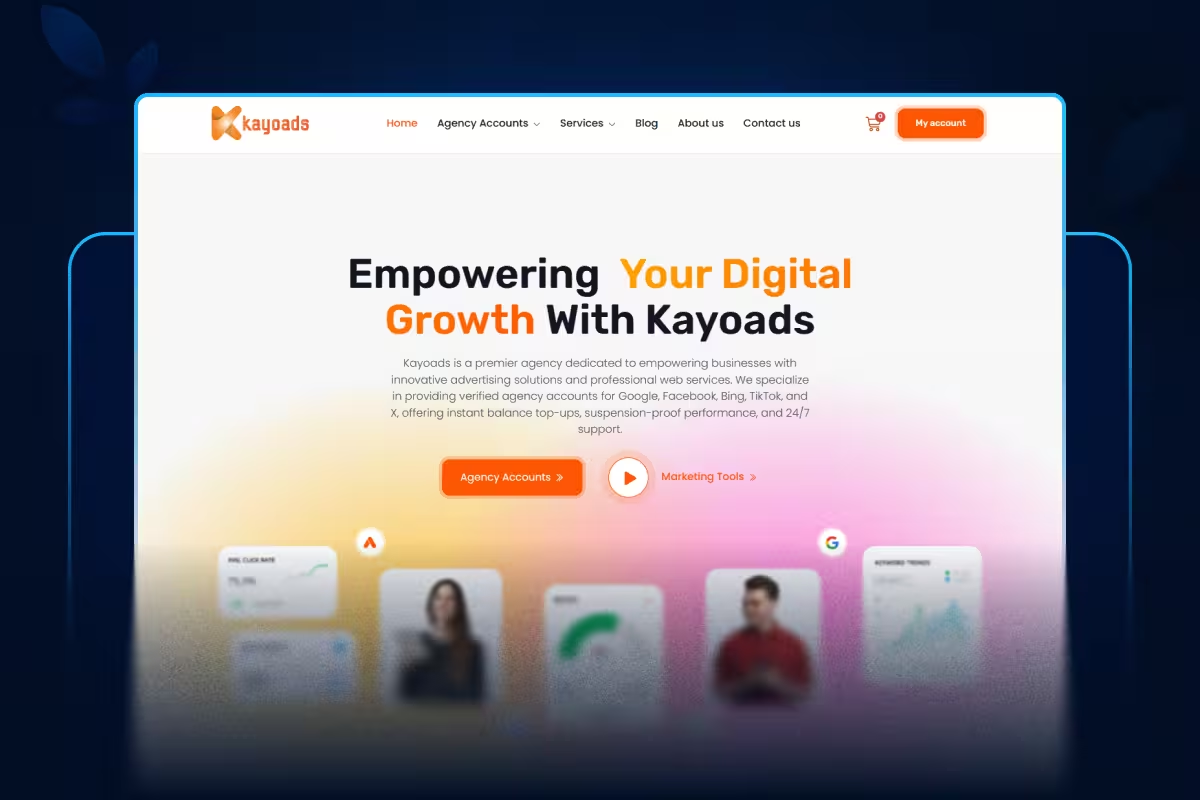
Kayoads focuses on making agency ad accounts accessible to smaller agencies and newer teams. Its primary goal is to lower the financial and technical barriers associated with entering the agency account ecosystem.
The platform is designed for agencies that are still testing their scalability or transitioning from standard business accounts. Instead of offering complex enterprise systems, Kayoads emphasizes simplicity, affordability, and quick deployment.
This approach makes Kayoads attractive to startups and solo agency owners who want to experiment with agency infrastructure without committing to large upfront investments. However, its simplified model also means that advanced features and deep support systems are limited.
Kayoads works best as an entry point rather than a long-term enterprise solution.
Key Features
- Entry-level agency ad account access
- Simplified onboarding procedures
- Basic billing and account management systems
- Short-term usage options
- Minimal documentation requirements
Pros
- Affordable access for small teams
- Quick setup process
- Low commitment requirements
- Easy-to-use interface
- Suitable for testing agency accounts
Cons
- Limited platform coverage
- Basic support structure
- Smaller infrastructure capacity
- Fewer compliance resources
5. Squarewave Agency

Squarewave Agency positions itself as a hybrid between an infrastructure provider and a strategic growth partner. Instead of focusing solely on account access, Squarewave integrates consulting, optimization, and risk management into its service offering.
The company works closely with client agencies to assess campaign structure, compliance risks, and scaling strategies. This makes Squarewave particularly appealing to agencies that value guidance and long-term planning over raw access.
Squarewave’s model emphasizes managed growth. Accounts are deployed gradually, monitored closely, and adjusted based on performance and risk indicators. This reduces volatility but may slow aggressive expansion.
Agencies that prefer a collaborative partnership rather than independent control often find Squarewave to be a good fit.
Key Features
- Managed account deployment systems
- Integrated campaign consulting services
- Compliance and risk audits
- Ongoing performance reviews
- Strategic growth planning
- Hands-on account supervision
Pros
- Active compliance monitoring
- Personalized guidance
- Reduced operational risk
- Suitable for developing agencies
Cons
- Higher service fees
- Less flexibility
- Slower scaling pace
- Limited raw account access
6. Tech4You.io

Tech4You focuses on providing technically flexible infrastructure for agencies operating across multiple advertising channels. Its platform is designed for teams that manage complex traffic ecosystems and require advanced integrations.
Rather than offering standardized packages, Tech4You emphasizes modular configurations. Agencies can combine different account types, billing systems, and data pipelines based on their operational needs.
This technical orientation makes Tech4You attractive to experienced media buying teams with in-house developers or technical specialists. However, it can be challenging for less technical agencies.
Tech4You is best suited for organizations that prioritize customization and system-level control.
Key Features
- Multi-platform account access
- Modular infrastructure design
- API and data integrations
- Cross-channel reporting systems
- Custom deployment configurations
Pros
- Broad platform coverage
- High customization potential
- Strong integration capabilities
- Suitable for advanced operations
- Flexible system architecture
Cons
- Complex onboarding
- Steep learning curve
- Inconsistent regional support
- Requires technical expertise
7. Laurel Agency

Laurel Agency operates as a boutique provider focused on quality, selectivity, and personalized service. Rather than scaling aggressively, Laurel limits its client base to maintain close operational control.
The company places strong emphasis on account quality, business verification, and long-term relationships. Agencies working with Laurel typically undergo a detailed vetting process before approval.
This selective approach results in higher average account stability and stronger provider-client alignment. However, it also limits availability and capacity.
Laurel is best suited for agencies serving premium brands and long-term clients.
Key Features
- Curated agency account portfolios
- Selective onboarding procedures
- Personalized account management
- Enhanced compliance screening
- High-trust account infrastructure
Pros
- High-quality account profiles
- Strong stability records
- Consistent operational standards
Cons
- Limited capacity
- Higher pricing structure
- Slower onboarding
- Not suitable for mass scaling
8. ThePinnacle.media

The Pinnacle Media focuses on delivering high-touch operational support and proactive account management. Its services are designed for agencies that prioritize continuity and protection over rapid growth.
The company assigns dedicated teams to monitor account performance, policy compliance, and financial activity. This allows potential issues to be identified early and addressed before they escalate.
Pinnacle’s model favors conservative scaling and long-term account preservation. While this reduces volatility, it can slow expansion for fast-growing agencies.
This provider is best suited for risk-averse teams managing mission-critical client campaigns.
Key Features
- Dedicated account management teams
- Continuous account monitoring
- Priority appeal handling
- Risk assessment frameworks
- Performance review systems
Pros
- Strong operational oversight
- High support availability
- Quick issue resolution
- Stable account environments
Cons
- Higher management fees
- Slower scaling processes
- Less experimental flexibility
- Conservative growth model
Why Agencies Can’t Rely on Personal or Standard Business Accounts
Many agencies begin their journey using personal profiles and basic business managers. At low volumes, this approach works. Problems emerge when spending increases and client portfolios grow.
New accounts are closely monitored by automated systems. Even minor policy mistakes, unusual spending patterns, or payment irregularities can trigger restrictions. Appeals may take weeks and often lack clear explanations.
Standard business accounts also face gradual limitations. Daily spend caps increase slowly. Support channels are limited. Payment issues can cause instant shutdowns. As client budgets rise, these structural weaknesses become bottlenecks.
More importantly, relying on fragile accounts exposes clients to unnecessary risk. A suspension does not only affect the agency. It disrupts client campaigns, lead pipelines, and revenue forecasts.
For agencies operating professionally, this level of instability becomes unacceptable.
Who Needs an Agency Ad Account Provider?
Not every advertiser needs agency-level infrastructure. Freelancers and small businesses can often succeed with standard accounts. However, certain business models strongly benefit from professional providers.
Agencies managing multiple brands, running high-frequency testing, operating in regulated niches, or handling large budgets usually require more stable foundations. Performance marketing firms, affiliate networks, and lead generation companies fall into this category.
E-commerce agencies scaling multiple stores, SaaS growth teams, and international media buying groups also benefit from centralized infrastructure. In these environments, account stability directly impacts profitability.
If your operation depends on continuous ad delivery, predictable billing, and long-term scalability, an agency ad account provider becomes a strategic asset rather than a convenience.
How Agency Ad Account Providers Work
Most providers follow a standardized operational model. Agencies begin by submitting applications detailing business structure, traffic sources, compliance history, and expected spend. Providers then assess risk and determine suitability.
After approval, agencies receive access to designated accounts through controlled permissions. Billing systems are configured, often using prepaid balances, credit lines, or managed invoicing.
Throughout the relationship, providers monitor account behavior, payment patterns, and policy compliance. When issues arise, they coordinate appeals, investigations, and replacements where applicable.
This centralized management allows providers to maintain portfolio-level stability while supporting individual agencies.
Key Criteria to Evaluate the Best Agency Ad Account Providers
Selecting a provider requires careful evaluation. Platform coverage determines traffic flexibility. Account history affects resilience. Replacement policies influence downtime risk. Billing transparency protects margins.
Compliance support reduces long-term exposure. Scalability ensures future growth. Data ownership protects strategic assets. Support quality affects crisis response. Contract terms influence flexibility.
Strong providers score consistently across these dimensions rather than excelling in only one area.
Final Thoughts
In 2026, agency ad account providers function as critical infrastructure partners. They enable agencies to operate at scale in increasingly regulated environments.
The best agency ad account providers emphasize stability, transparency, and sustainable growth rather than unrealistic promises. Platforms like Uproas, AdLaunch, and Squarewave serve different operational models, making provider selection a strategic decision.
Agencies that invest in strong infrastructure early are better positioned to grow, retain clients, and compete in high-pressure advertising markets.
Frequently Asked Questions
How to Rent a Facebook Agency Ad Account?
You apply through a provider, submit documentation, and receive managed access after approval. Fees typically include setup and usage costs. Check out our Facebook agency ad accounts.
Are Agency Ad Accounts Legal?
Yes, when provided through legitimate businesses following platform policies. Misuse still carries risk.
Can I Use My Own Pixel?
Most providers allow pixel integration, subject to technical and contractual terms.
What Happens If an Account Gets Banned?
Providers investigate, appeal when possible, and may issue replacements depending on agreements.
Do Providers Guarantee No Bans?
No legitimate provider can guarantee permanent immunity. Risk management, not elimination, is the goal.
Can I Migrate Clients Later?
Yes, though rebuilding audiences and data may be required.


Latest blogs

Marketing Mix Modeling: Master Revenue Growth
Stop trusting broken attribution data. Learn how marketing mix modeling bypasses tracking limits to uncover true revenue and optimize ad spend.
Types of Retargeting: The Full Guide for Marketers
Explore major types of retargeting, from pixel-based to dynamic and sequential, and learn how to combine them into a converting campaign.
Targeted Advertising: How It Works and How to Use It Well
Build a bulletproof targeted advertising strategy. Turn raw behavioral data into profitable segments using our step-by-step optimization plan.
Retargeting vs Remarketing: The Difference Every Marketer Needs to Know
Stop treating Retargeting vs Remarketing as identical. Use a precise, high-impact framework to weaponize your data and maximize conversions.

Google Ads Cost: What You'll Really Pay (By Industry, Campaign Type, and Business Size)
Stop wasting budget on vague pricing. See exact 2026 Google ads cost benchmarks by industry, real CPC data, and the formula to reduce your ad spend.

Types of Facebook Ads: A Complete Guide to Every Format in 2026
See all types of Facebook ads, including current specs, placements, and objectives, plus a matching table to pick the right format for your goal.
ABM Stats: 2026 Benchmarks, ROI & Trends
From ROI to pipeline velocity, these 2026 ABM stats show exactly why account-based marketing dominates B2B growth.
.jpg)
The Real Price of Social Media Advertising: A Cost Guide for Advertisers
Find out what social media ads actually cost these days. Get to know about CPC, CPM, CPL, industry verticals, budget ranges, and ROAS across major platforms.
Bing Ads Cost in 2026: Everything You Need to Know
Stop wasting money on ad spend. See the 2026 Bing Ads cost benchmarks, real industry CPAs, and hidden ROI data you need to outperform competitors.